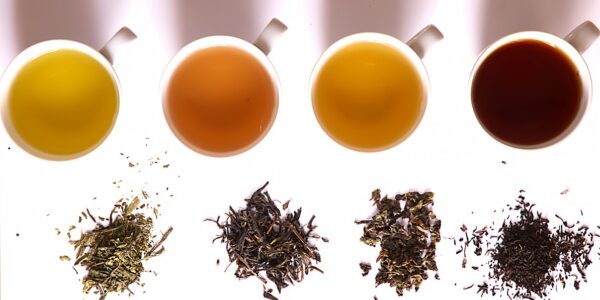
Not to be confused with the various (branded) blends of tea.
All tea comes from one plant – Camellia sinensis. The varieties of tea come purely from what happens to the tea leaves after they are picked.
There are six main varieties of tea. (Or varia-teas if you wish).
These are the steps that lead to the most popular types of tea.
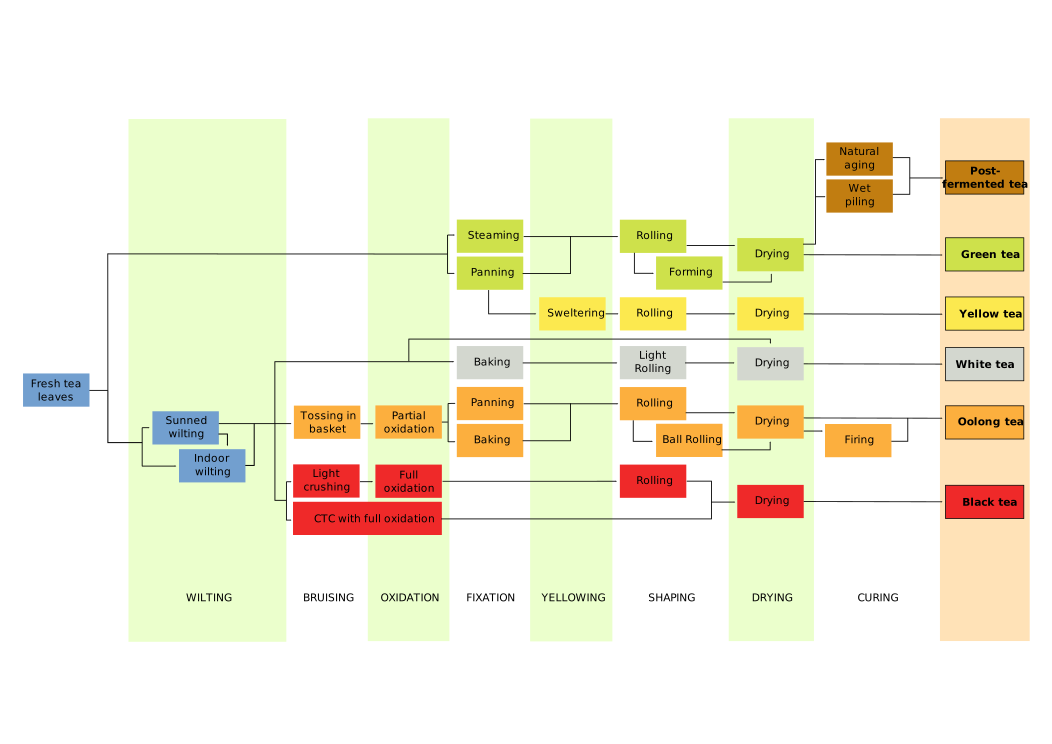
What type of tea you get is based on the degree or period of oxidation or fermentation of the leaves.
Green tea
Green tea undergoes the least amount of oxidation. You must quickly stop the oxidation process by the quick application of heat after you pick the tea.
There are two ways to make tea green but it must be done within one to two days of harvesting.
- With steam which is the method preferred in Japan. Steamed varieties usually have a more vivid colour.
- With dry roasting in hot pans which is preferred in Chinese-style tea processing. Generally, roasted varieties are richer in flavour.
The tea leaves are then either left to dry as separate leaves or rolled into small pellets to make gunpowder tea. The balling process is time-consuming and is typically done with pekoes of higher quality.
Yellow tea
Yellow tea is processed in a similar way to green tea. Instead of immediately drying after fixation, the tea is gently heated in a humid environment.
This initiates oxidation in the chlorophyll of the leaves through non-enzymatic and non-microbial means, which results in a yellowish or greenish-yellow colour.
Tea Processing, Wikipedia
White tea
For white tea, you need to wither and then bake the leaves to stop the oxidative process. You end up with a delicate mild flavour.
Until relatively recently white tea was made in small quantities but interest in it has increased which may have lowered the cost of white tea.
Oolong tea
This tea’s oxidation is stopped somewhere between the standards for green tea and black tea. The processing typically takes two to three days from withering to drying with a relatively short oxidation period of several hours. In this regard, most Darjeeling teas with light oxidation levels are more similar to green or oolong teas. In Chinese, semi-oxidized teas are collectively grouped as blue tea (青茶, literally: blue-green tea; also, celadon tea, for the pottery), while the term oolong is used specifically as a name for certain semi-oxidized teas. Common wisdom about lightly oxidized teas in Taiwan (a large producer of Oolong) is that too little oxidation upsets the stomachs of some consumers. Even so, some producers attempt to minimize oxidation to produce a specific taste or allow the tea leaves to be easily rolled into the spherical or half-sphere form demanded by buyers in the market.
Tea Processing, Wikipedia
Black tea
If you buy supermarket tea or want a mug of “builder’s tea”, black tea is what you get. PG Tips, Yorkshire tea, Tetlee, and all the others are black teas.
For black tea, the tea leaves are withered, dried, and completely oxidized. Black tea is first withered to induce protein breakdown and reduce water content (68–77% of original).
Orthodox processed black teas are further graded according to the post-production leaf quality by the Orange Pekoe system, while crush, tear, curl (CTC) teas use a different grading system. Orthodox tea leaves are heavily rolled either by hand or mechanically on a cylindrical rolling table or a rotor vane. The rolling table consists of a ridged table-top moving in an eccentric manner to a large hopper of tea leaves, of which the leaves are pressed down onto the table-top. The process produces a mixture of whole and broken leaves, and particles which are then sorted, oxidized, and dried. The rotovate consists of an auger pushing withered tea leaves through a vane cylinder which crushes and evenly cuts the leaves. Crush, tear, curl is a production method developed by William McKercher in 1930 which uses machines with contra-rotating rotors with surface patterning that cut and tear the leaves producing a product popular for use in tea bags. The rotovate is often used to pre-cut the withered tea prior to the CTC and to create broken orthodox processed black tea.
Tea Processing, Wikipedia
Post-fermented tea
Teas that are allowed to undergo a second oxidation after the fixation of the tea leaves, such as Pu-erh, Liu’an, and Liubao, are collectively referred to as secondary or post-fermentation teas in English.[39] In Chinese they are categorized as Dark tea or black tea. This is not to be confused with the English term Black tea, known in Chinese as red tea. Pu-erh, also known as Póu léi (Polee) in Cantonese is the most common type of post-fermentation tea in the market.
Tea Processing, Wikipedia


Mentions
Comments are closed.